
Artist Margaret Woodward breathes new life into a forgotten semaphore code.
I think of time spent in the library and archives as divining or prospecting – a process of uncovering unexpected things displaced from memory. – Margaret Woodward
Margaret was awarded the first Creative Fellowship at the State Library and Archives of Tasmania in 2024. The exhibition Semaphore Score presents her art and research alongside the histories, language and artefacts she explored as a Fellow.
In particular, Semaphore Score is inspired by one extraordinary item Margaret discovered in the State Library and Archives of Tasmania collection – the 1868 Tasman Peninsula – Semaphore Code Dictionary.
The dictionary lists more than 3,000 words and phrases used by colonial administrators to communicate between Nipaluna/Hobart and the penal settlement at Port Arthur.
From 1834 to 1877 messages were sent across a network of signal stations between Tukana/Tasman Peninsula and Nipaluna/Hobart via flags and wooden structures with movable arms.
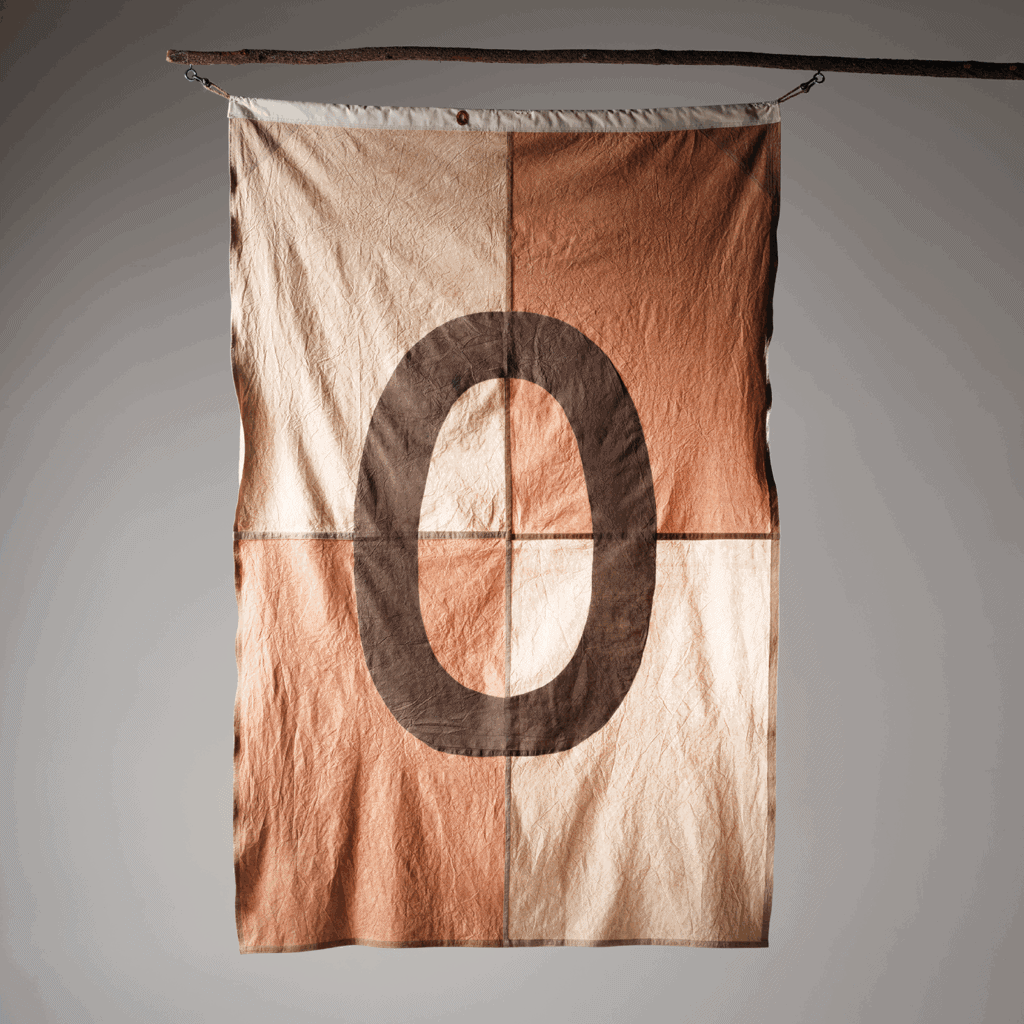
The handmade flags in Semaphore Score mirror the positions of the signal arms, each representing a number from 0 through to 9. They have been dyed using local plants Margaret collected, connecting them to the landscape of Lutruwita/Tasmania.
A new semaphore code
Margaret created a Semaphore Score code book in response to her enquiry:
Through this artwork I ask myself how this militaristic language might be … recomposed to create messages of care, concern and stewardship.
Keeping some of the original entries and introducing new ones, her modern code book offers a thoughtfully renewed vocabulary that expands on – and challenges – the 1868 dictionary. The new code and flags were used to send public messages at The Unconformity in Queenstown in October 2025.
Visiting the exhibition
Explore the Semaphore Code Dictionary, the handmade flags and the artefacts Margaret researched during her Creative Fellowship.
Write your own message using the signal card provided. Drop your signal card into the Semaphore Score post box to be transcribed into the Semaphore Score logbook.
Discover talks and events. Book on Eventbrite.
The Semaphore Score code book can be purchased at the front desk for $10.
Free exhibition
14 February – 31 May 2026
State Library and Archives of Tasmania
Allport Library and Museum of Fine Arts
Ground Floor, 91 Murray Street
Nipaluna/Hobart, Lutruwita/Tasmania
- Monday to Friday 9:30 am to 6:00 pm
- Saturday 9:30 am to 2:00 pm
- Sunday 9:30 am to 12:30 pm
- closed public holidays
Free entry, no bookings required.
View exhibition items in our catalogue
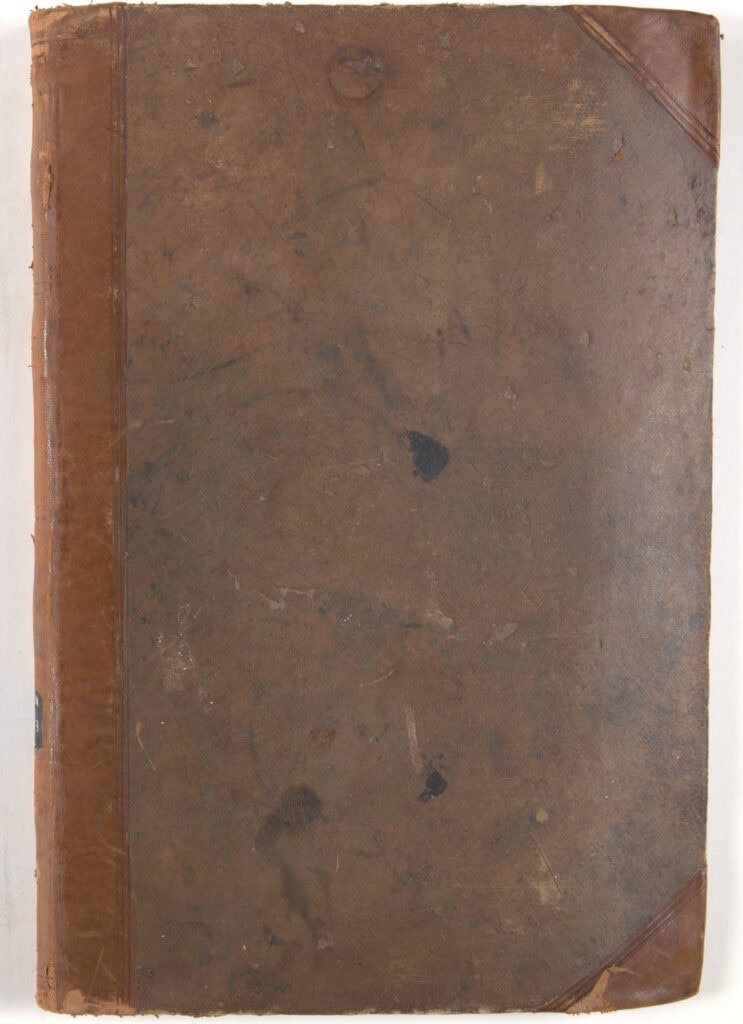
Tasman Peninsula – Semaphore Code Dictionary
(1868) CON133/1/1
Journal and Miscellaneous Papers of Charles O’Hara Booth
(1815–1838) NS8/1/1 (Charles O’Hara Booth created the semaphore signals and code books used in Hobart.)
Hobart Town Almanack for the year MDCCCXXIX (1829)
Dr James Ross
Hobart Town almanack and Van Diemen’s Land annual 1837–1838
William Elliston
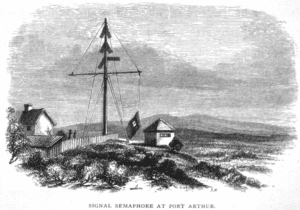
Signal semaphore at Port Arthur
(1872) Richard Bentley, engraving, 7 x 10 cm
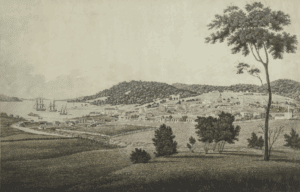
South-west view of Hobart Town Van Diemen’s Land
(1820) George William Evans (1780–1852) engraving and aquatint, 36 x 49 cm, FA476
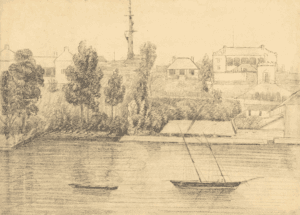
Our cottage at Port Arthur, [Capt?] and signal staff, and barracks
(1844) Eliza Errington (1808–1869), pencil on paper, 30 x 36.1 cm, FA1270
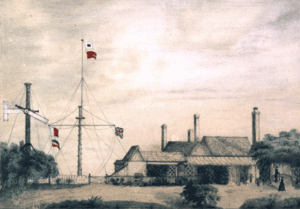
View of the cottage at the Flag Staff station Launceston, Tasmania
(1854) Charlotte Cleveland (1819–1884) pencil, ink and watercolour, 13.4 x 19.4 cm (within mount), FA241
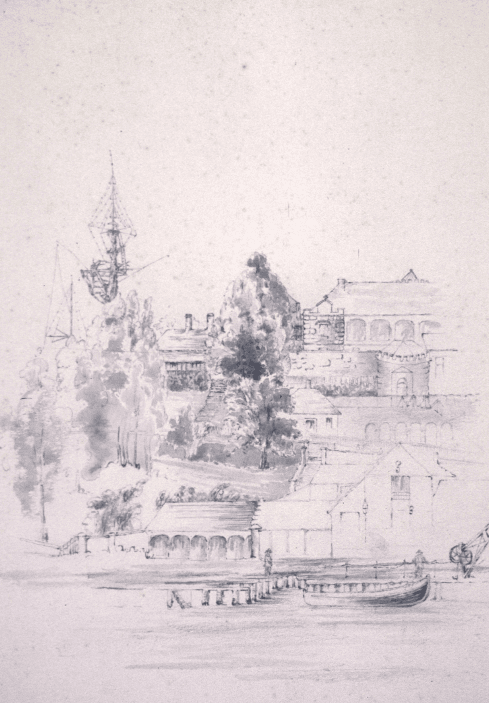
Port Arthur View
(1860?), artist unknown, pen, pencil and wash drawing, 28 x 19 cm, FA257
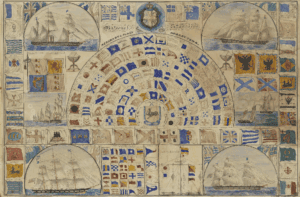
National standards: merchants flags, Hobart Town
(1855) Private Edward Murphy 99th Regiment (1823–1871), watercolour, pen and ink on paper; 57 x 87 cm, FA956
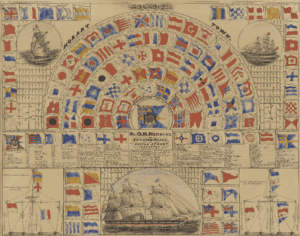
Signals Hobart Town
(1855) Private Edward Murphy 99th Regiment (1823–1871), watercolour, pen and ink on paper, 45 x 58 cm
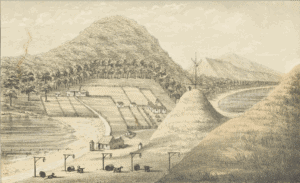
North view of Eagle Hawk Neck, which joins Tasman’s Peninsular to the main land of Van Dieman’s Land
(184-) From a sketch by Capt. Charles Staniforth Hext, 4th. The King’s Own Regiment (1815–1855); C. Hutchins, lithographer. 2-col. lithograph; 24 x 31 cm FA213
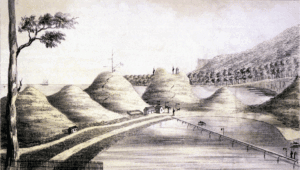
South view of Eagle Hawk Neck, Van Dieman’s Land
(184-) From a sketch by Capt. Charles Staniforth Hext, 4th. The King’s Own Regiment (1815–1855); C. Hutchins, lithographer. 2-col. lithograph; 24 x 31 cm FA214
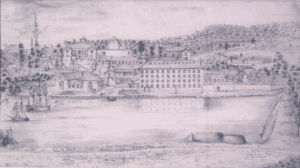
North-East view of the Settlement of Port Arthur
(1854) Artist unknown. Pencil on paper, 30 x 53 cm (framed size), FA231
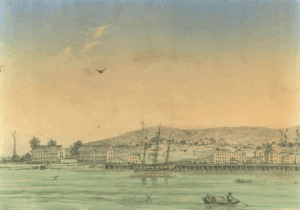
The New Wharf and Battery Point circa 1856
(c. 1856) Artist unknown. Pencil on scraperboard backed with linen, 30 x 42 cm
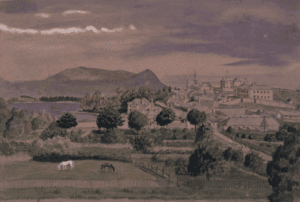
Port Arthur, Tasmania
(1872) Artist unknown. Watercolour on tinted paper, 17 x 25 cm (framed size), FA538